- Bottom of the Ninth
- Posts
- 👨🦯 Blind Fans Can Finally "Watch" Sports, Here's How...
👨🦯 Blind Fans Can Finally "Watch" Sports, Here's How...
OneCourt, sports' newest accessibility tool

Tyler Webb
December 29, 2025
In partnership with


Happy Wednesday,
Sports have spent 35 years treating accessibility like a compliance box; ADA passes in 1990, venues add ramps, seating sections, signage, and everyone calls it progress.
But there’s a quieter problem the industry never really addressed: once a blind or low-vision fan gets into the building, the game itself is still hard to follow.
Sports are fundamentally spatial, and while sighted fans can absorb that information instantly, blind fans usually can’t.
That’s the gap OneCourt was built to close.
Founded in 2021 at the University of Washington, OneCourt started after co-founder Jerred Mace saw a blind fan follow a soccer match by touch, guided by a friend’s hand. It raised a simple but uncomfortable question: if sports are supposed to be for everyone, why is the core experience still so dependent on vision?
This week, Jake and I sat down with the OneCourt team to talk about how accessibility is starting to shift from a legal requirement to an experience problem, and why real-time tracking data is finally making that shift possible.
Stop Planning. Start Building.
End of the year? Or time to start something new.
With beehiiv, this quiet stretch of time can become your biggest advantage. Their platform gives you all the tools you need to make real progress, real fast.
In just days (or even minutes) you can:
Build a fully-functioning website with the AI website builder
Launch a professional-looking newsletter
Earn money on autopilot with the beehiiv ad network
Host all of your content on one easy-to-use platform
If you’re looking to have a breakthrough year, beehiiv is the place to start. And to help motivate you even more, we’re giving you 30% off for three months with code BIG30.
5 Takeaways From Our Conversation With OneCourt
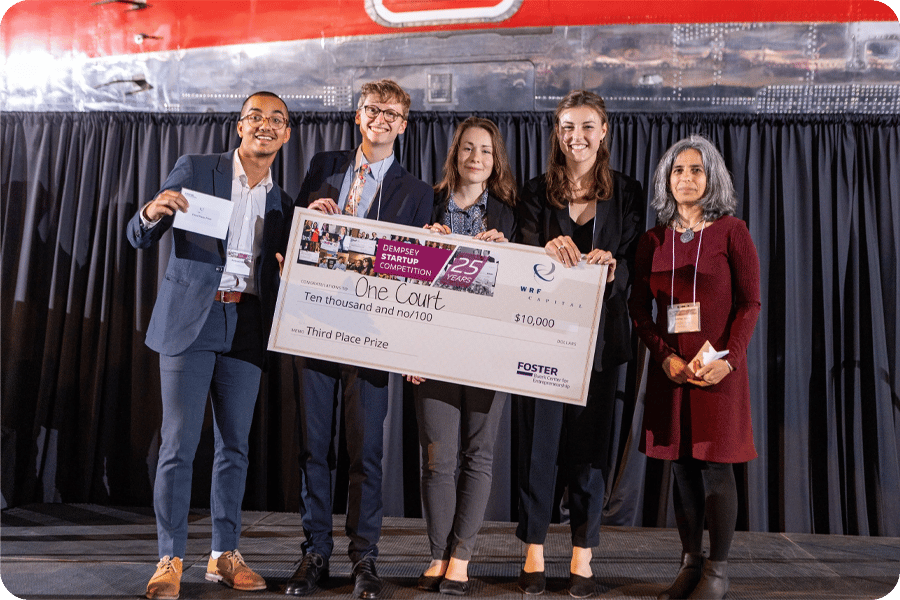
Left, Antyush Bollini and Jerred Mace, Co-Founders of OneCourt
1. The industry’s failure wasn’t access; it was experience
Jerred’s origin story is simple: he saw a blind fan “watching” a match using a DIY tactile board. The fan was there, but the sport still wasn’t for him.
That’s the core failure OneCourt is solving: sports stopped at entry instead of building inclusion once you’re inside the venue.
This is why the problem is bigger than “better commentary.” It’s about whether the product delivers the thing fans are actually there for: real-time understanding.
2. Audio-only fandom is delayed, dependent, and exhausting
Blind and low-vision fans typically rely on radio calls or sighted companions, and both create the same problem: you’re always behind the moment.
Jerred broke down the two killers:
Audio is missing spatial detail
It often comes with delay (in-stadium radios can lag 10–30 seconds)
So the fan experience becomes passive: What just happened? Why is everyone reacting? Where’s the ball?
“You kind of lose that interpretive lens… you’re holding onto someone else’s interpretation of the game.”
That’s not fandom.
3. OneCourt’s insight is spatial awareness, not “accessibility features”
This is the part most sports execs haven’t fully internalized:
Sighted fans don’t just “see,” they intuitively track where the ball is, how plays develop, and why momentum shifts. That spatial context is the game.
OneCourt is a tactile broadcast: a haptic display that lets fans follow the action with their fingertips. The device has tactile court lines on top, and pinpoint vibrations underneath that move in real time based on tracking data.
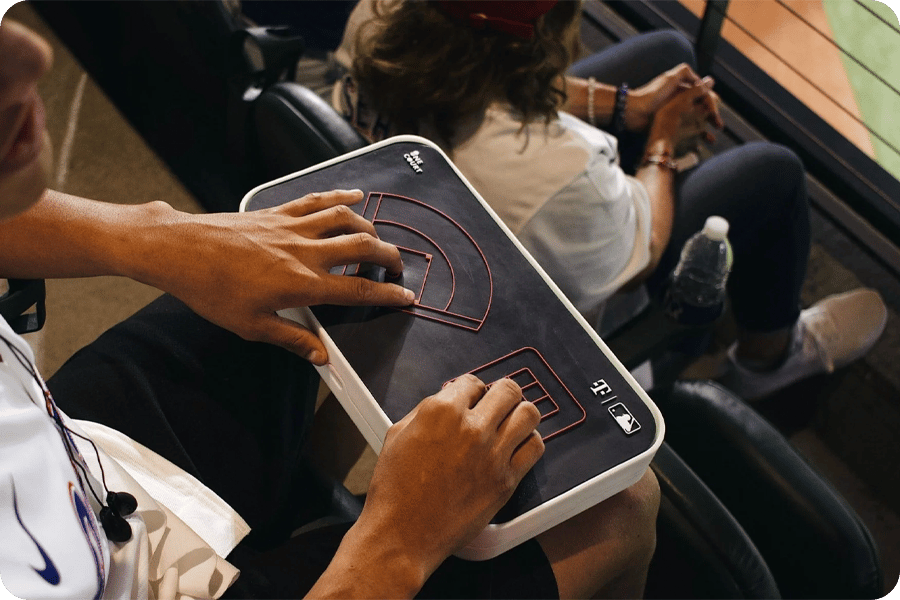
OneCourt Device being used at the 2024 MLB All-Star Game
Jerred’s clearest explanation: “It’s like a screen that you can feel.”
This reframes accessibility from “accommodations” to experience design.
4. Adoption accelerated because OneCourt doesn’t create operational pain
A big reason OneCourt is working: it doesn’t require venues to rebuild anything.
It uses tracking data that leagues already collect. No new cameras. No installs. No venue infrastructure changes. Devices are distributed through guest services just like other accessibility tools.
That operational simplicity is the unlock.
Jerred also made the early resistance sound more logistical than philosophical: teams generally liked the idea — they just didn’t want it to create IT work, staff burden, or game-day friction.
Once teams realized it wouldn’t slow down operations, momentum picked up fast.
5. Ticketmaster (and the NBA) pushed accessibility closer to marketing and revenue
OneCourt’s NBA work has been sponsored by Ticketmaster, and that matters because it reframes the purchase.
Instead of “an accessibility cost,” it becomes:
Inclusion + brand activation
Partner storytelling
A new category of fan experience tech
Teams start evaluating it differently when it lives in the same universe as sponsorship and guest experience, not just legal/ops.
You can see how this changes behavior in rollouts like the Atlanta Hawks, who made OneCourt available at every home game (not just a pilot): five devices, free to fans, first-come, first-served. The framing was “guest experience innovation,” not experimentation.
And on the league side, the NBA’s culture of being first on tracking, alternate broadcasts, and fan tech shows up again here. Antyush summed up why:
“They are seen as the most tech-forward league… their audience is younger… they’re very focused on innovation.”
Plus: programs like NBA Launchpad gave OneCourt credibility and speed that startups usually don’t get on their own.
Why It Matters
Sports accessibility is quietly shifting.
For decades, it was compliance-driven: Can you enter? Can you sit? Can you get to the bathroom?
Now the question is becoming: Can you actually follow the game and feel like a fan?
That’s a different standard—and it puts accessibility in the same bucket as premium seating, hospitality, and fan experience design.
OneCourt is also a case study in how sports data finally becomes useful beyond novelty. Player/ball tracking isn’t just for betting overlays or cartoon broadcasts. It can power entirely new ways to consume sports.
And the long-term implication is bigger than OneCourt:
Accessibility is moving from obligation → expectation → advantage.
The teams that understand that early will win loyalty — not just from disabled fans, but from the families and friends who attend with them (and multiply the impact). There are roughly 7M Americans with blindness or vision loss. That’s not tiny, and it’s not isolated.
The industry just hasn’t been building for them.
📩 And don’t forget: Bottom of the Ninth is back this Friday with the top three stories in sports and business from the week.
See you then,
Tyler & Jake
Reply