- Bottom of the Ninth
- Posts
- ☀️ How is the NHL Pulling Off an Outdoor Game in Miami?
☀️ How is the NHL Pulling Off an Outdoor Game in Miami?
Plus, meet the NFL's new "secret obsession"

Tyler Webb
January 02, 2026


I’m sure many of you reading this are in a couple of Fantasy Football leagues every year, but we all have that one that just means more.
For me, it’s a league with eight high school buddies that we’ve been running for 12 years.
Now, don’t get me wrong, it’s great to win the office fantasy championship, but beating Isaac G. for my 2nd championship (in three years, dynasty watch?)… that just means more.
In today’s newsletter:
🗞 The Big Story: How is the NHL Pulling Off an Outdoor Game in Miami?
📉 Biggest Loser: Meet the NFL’s New “Secret Obsession" - Supersonic Travel
🏆 Winner’s Circle: This Leg Brace Might Be Saving Michael Porter Jr.’s Career
🗞 The Big Story

Rendering via NHL
How the hell is the NHL going to play an outdoor hockey game in Miami, FL?
Well, pulling it off is actually a lot easier than you might think, but no one seems to understand why. Let’s break it down.
Background: When the NHL announced last year that they’d be hosting the first-ever outdoor hockey game in Florida at Miami’s loanDepot Park, fans rightfully started questioning how that would even be possible.
For context, as recently as 2021, the league had to delay both of its outdoor games in Lake Tahoe by 8 hours due to melting ice, and the average winter high there is still 44 °F; meanwhile, the weather this week in Miami is expected to reach as high as 79 degrees.
So what’s the NHL’s plan here?

Crews working to fix the ice in Lake Tahoe (2021)
Staying Cool: For starters, loanDepot Park has a retractable roof and windows. This means, for the four days it took to build the rink and the seven days it took to build the ice, the stadium has been completely closed, and the air conditioning has been blasting to keep the temperature in the low 60s.
However, while that’s plenty cold to keep the ice frozen, the NHL has already said it plans to open the roof and the windows during the game.
That’s why, for the first time, instead of bringing in just one 300-ton, 53-foot refrigeration trailer, the league is bringing in two.
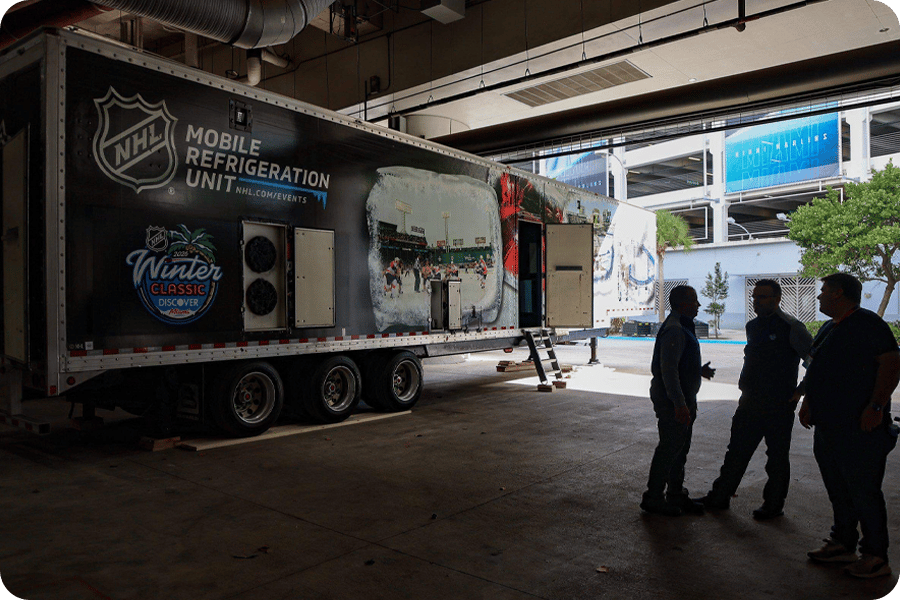
These trailers, which are custom-built for the Winter Classic, will sit in the loading dock so they can easily vent warm air. Meanwhile, each one will pump up to 3,000 gallons of glycol coolant through 253 aluminum pans on which the actual ice will sit.
This allows the ice crew to cool the surface beneath the ice to an impressive 22 degrees, helping to ensure that, regardless of the air temperature, the ice will stay frozen throughout the entire game.
The NHL has also said it plans to build more ice than the standard 1 1/2 to 2 inches for this specific game.
Still, none of this solves for the NHL’s biggest variable this week: the weather.
Forecast in Miami: Ice technicians have already spent 22 hours at the ballpark studying how the sun’s path will impact the ice, and even though the high for the game is close to 70 degrees, by puck drop at 8 PM ET, temperatures will likely be closer to 59 degrees.
Now all that’s left to do is hope for no rain.
📉 Biggest Loser

The NFL has a new secret obsession that could help them make billions, but they seem to be ignoring one massive problem.
Keeping Tabs: A few weeks ago, the Wall Street Journal published an article that said league executives have been “quietly monitoring” the progress of Supersonic travel in their efforts to place “an NFL team — or perhaps an entire division” in Europe.
Now, for those of us who aren’t old enough to remember, we actually had daily Supersonic travel from 1976 to 2003, which allowed people to fly across the Atlantic faster than the speed of sound—resulting in a trip between New York and London taking just 3.5 hours, as compared to 7 or 8 hours on a normal plane.

However, due to rising costs and a high-profile crash, the now-infamous Concord jet was grounded for good, and most air travel hasn’t gotten faster in almost 30 years.
In fact, one source told the Wall Street Journal that “the only reason” the NFL hasn’t already expanded to Europe is because of the current “speed of travel.”
So what changed?
Recent Developments: Well, in recent years, a number of companies, including Boom Supersonic, have been developing a new kind of airplane that can reach speeds of around 1,300 MPH over the ocean, which is almost twice the speed of sound.
This means it would take a team in New York less time to travel to Europe than to travel to Los Angeles.
Now, the financial upside of Supersonic travel for the NFL is obvious, since it gives them the ability to add four teams in Europe, which equals:
More fans
More games
Billions more in TV revenue every year
But even though jets like Boom Supersonic’s Overture aren’t set to carry its first commercial passengers until at least 2029, it’s not actually the timeline of this technology that the league should be most concerned about.
Limitations: Instead, it’s the fact that even once these planes are finished, they’re only expected to carry about 60 to 80 people, which is far less than the 200 people who travel with every NFL away team.
So, unless the league wants to shell out for several of these things for its own private use, it might be a while before the NFL completes its goal of world domination.
🏆 Winner’s Circle
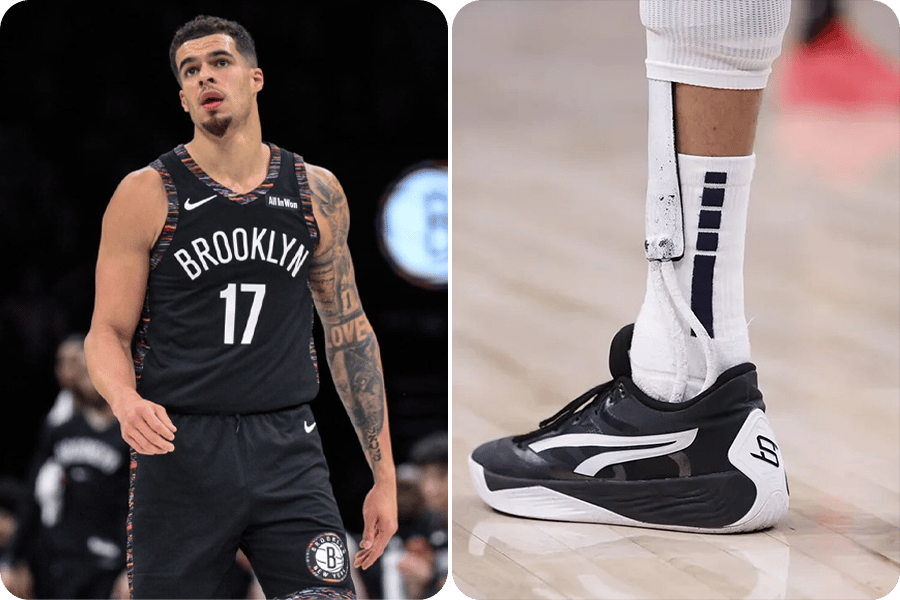
What the heck is this thing around Michael Porter Jr.’s leg?
Well, it’s actually a brace for one of the craziest injuries I’ve ever heard of an athlete playing through. Let me explain.
Background: If you recall, when Porter Jr. came out of high school, he was projected to be the first overall pick in a draft that featured multiple future All-Stars, including:
Luka Dončić (3rd overall)
Jaren Jackson Jr. (4th overall)
Trae Young (5th overall)
Shai Gilgeous-Alexander (11th overall)
Jalen Brunson (33rd overall)
However, after undergoing his first of several back surgeries in college and receiving what one league executive called “the worst pre-draft medical report” he had ever seen, with another team doctor saying that he “would never play basketball again,” Porter Jr. plummeted in the 2018 Draft to number 14 overall.

And even after two more back surgeries, which resulted in him playing in just 129 games in his first four seasons, Porter Jr. still managed to sign a max contract extension in 2021 for $207 million, and it might all be thanks to a brace.
“Drop Foot” Brace: Porter Jr. has actually been wearing this brace since his NBA debut in 2019; however, only recently have fans started pointing out the absurdity of what it’s doing.
That’s because this brace, which is most often used by stroke victims, is actually helping him with a condition called “drop foot.” This means that Porter Jr. is literally unable to lift the front of his foot due to nerve damage from his multiple lower back surgeries.
So this brace, which actually includes a plate that sits under his foot, is the only thing holding his foot up as he runs up and down the court.
And while doctors are still hoping that his nerves can heal enough for him to regain full strength in his foot, until then, Porter Jr. will have to continue hooping in one of the most unique braces in all of sports.
⏱️ In Other News
When you refer new readers to the Bottom of the Ninth, you win exclusive prizes.

➡️ Here is your unique link to share: https://bottom-of-the-ninth.beehiiv.com/subscribe?ref=PLACEHOLDER
You’re currently at 0. That’s only 1 away from receiving a Bottom of the Ninth Sticker!
*Please do not use fake email addresses — they will not qualify as referrals. Thank you!
👋🏻 Happy Friday!
There’s a good chance you saw an email from me this week that started “Happy Wednesday,” but actually came out on Monday night at 9:45 PM.
That was clearly a mistake.
What happened was, the scheduling feature on Beehiiv (the platform I use to send these emails) wasn’t working, and in a fit of frustration, I started spamming different buttons and accidentally hit “Publish Now.”
So, in case you missed your regular Wednesday edition of BOTN… here it is.
Reply